

Hello, this is Izumitani from Ehime Film Commission.
On January 28, the Motion Picture Producers Association of Japan released its annual industry statistics. After following these numbers for more than 20 years, I found myself thinking: something has shifted. Maybe we’ve reached a tipping point.
Here’s why.
In 2025, 188 million people attended cinemas in Japan — a 130% increase over the previous year’s 144 million. Box office revenue reached ¥274.4 billion — up 132% from the previous year’s ¥206.9 billion. The split between domestic and foreign films was 75% Japanese vs. 25% international.
Both figures surpassed the previous year by over 30%, and domestic films clearly dominated. The surge is driven largely by theatrical adaptations of TV dramas and anime films based on manga, as well as the growing practice of fans attending the same film multiple times for limited-edition exclusive merchandise.
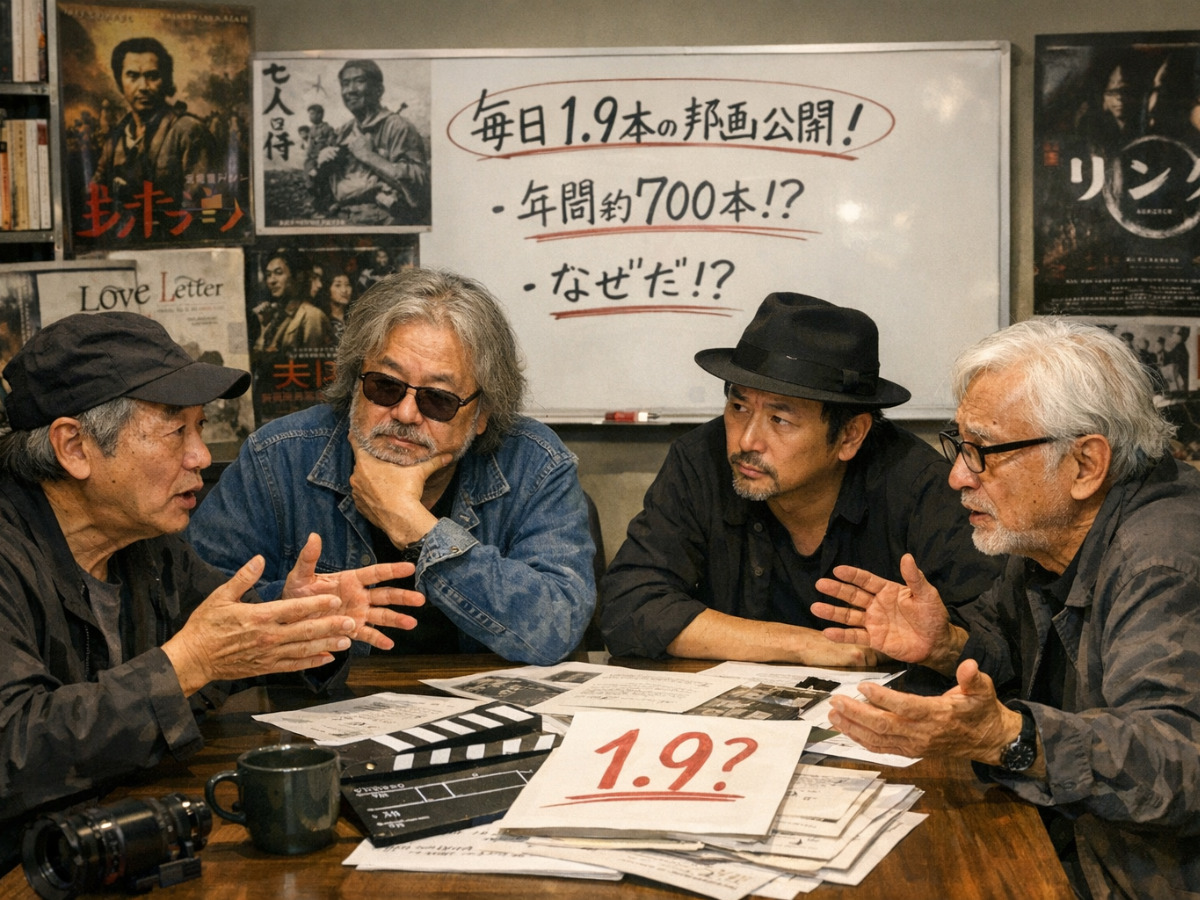
The total number of Japanese films released in 2025 reached 694 — a new all-time record. The previous high was 689 in 2019, with 685 in 2024 almost matching it. Now we’ve cleared 694. That’s nearly two new Japanese films premiering in theaters every single day.
For comparison, in the year 2000, 282 Japanese films were released. In 25 years, the number has grown 2.46 times.
So far, this sounds like a boom. But here’s where it gets complicated.
There is, in all seriousness, no single person alive who has seen every film released in Japan in a given year. That’s not an exaggeration — it’s a structural reality.
And I’m not entirely sure whether that’s a good thing, a bad thing, or simply irrelevant. But I do think it’s something we need to sit with honestly rather than look away from.
The industry statistics only track films that earn ¥1 billion (roughly $6.5M USD) or more at the box office.
Of the 694 films released in 2025, only 38 crossed that threshold — about 5%.
Those 38 films collectively earned ¥167.2 billion — 60% of the total ¥274.4 billion box office.
Even more striking: in 2025, four films individually surpassed ¥10 billion — the first time this has happened in Japanese film history. They were Demon Slayer: Infinity Castle / Kimetsu no Yaiba: Mugen-jou-hen Dai-isshou — Akaza Sairan (¥39.1B), National Treasure / Kokuhou (¥19.5B), Detective Conan: The One-Eyed Remnant / Meitantei Conan: Sekigan no Zanzou (¥14.7B), and Chainsaw Man: Reze Arc / Chainsaw Man — Reze-hen (¥10.4B).
That leaves ¥107.2 billion split across the remaining 656 films. Simple division yields an average of ¥163 million per film (roughly $1M USD). Apply the standard industry split where theaters take roughly half, and the average net revenue per film is around ¥80 million.
Even at the low end, a typical production budget for a Japanese feature film starts around ¥200 million. That means the average film in this category is losing over ¥100 million.
Some people look at these numbers and see a thriving industry. Others see an unsustainable one. Both are right, depending on what they’re looking at.
The question isn’t which narrative to believe — it’s whether we’re willing to hold both at once.